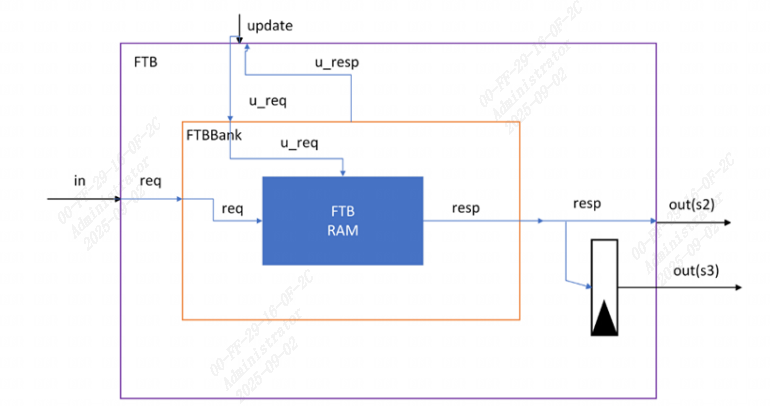
Xiangshan_BPU_FTB 简介 FTB 是香山 BPU 的第三个子预测器,它也能一并获取到 uFTB 和 TAGE-SC 的输出。在 FTB 的输入接口中,s1 通道含有 uFTB 的基础预测结果,s2 通道和 s3 通道中仅有 br_taken_mask 一组信号被 TAGE-SC 填充,并无 FTB 项生成的基础预测结果。FTB 的工作便是为 s2 和 s3 通道提供基础预测结果。
FTB 在功能和结构上都与 uFTB 类似,其主要区别就是 FTB 能够容纳更多的 FTB 项,并且 FTB 的预测结果是在 s2 与 s3 通道输出。正是由于容量大,其读出的速度上会比 uFTB 慢,无法被放置在第一周期产生预测结果,但大容量也使它能够获得更加精准的预测结果。
功能概述
接收请求
S0阶段时,FTB向内部FTBbank发送读请求,其请求pc值为S0传入的PC.
发送请求的下一拍 S1,暂存从FTB SRAM读出的多路信号。
S2从暂存数据中根据各路tag和实际请求时tag匹配情况生成命中信号并在命中时选出命中的FTB数据,若存在hit请求,则返回值为选出的 FTB 项及命中的路信息。
FTBBank 模块读出的数据在FTB模块内作为 2 阶段的预测结果以组合逻辑连线形式在当拍传递给后续预 测器,此外这一读出的结果还会被暂存到 FTB 模块内,在 3 阶段作为预测结果再次以组合逻辑连线传递给后续 预测器。若 FTB 命中,则读出的命中路编号也会作为 meta 信息在 s3 与命中信息、周期数一起传递给后续 FTQ 模块。
数据更新 收到update请求后,FTB会根据meta中的hit信息来决定更新时间,若meta中为hit,则本拍更新,否则要延迟两周期等待读出FTB内现有结果后更新。
在FTBBank内部,当存在更新请求时,该模块行为也因立即更新和推迟更新两情况而有所不同。立即更新时,FTBBank内的 SRAM写通道拉高,按照给定的信息完成写入。
推迟更新时,FTBbank首先收到一个update的读请求,下一拍读出数据,选出给定地址命中的路编码传递给外部FTB模块,而若这一拍未命中,则下一拍需要写入到分配的路中。路选取规则为,若所有路均已写满,则使用替换算法。
SRAM规格 单bank,512set,4way,使用单口SRAM,无读保持,有上电复位。 20bit tag,60bit FTB项。
FTB存储结构 FTB项
total
valid
brSlot
tailSlot
pftAddr
carry
isCall, isRet, isJalr
有效位
第一条分支信息
第二条分支信息
预测块结束地址
结束地址高位是否进位
tailSlot分支类型
RAS标识特殊位
强 bias
62
1
21
29
4
1
3
1
2
FTB slot
total
valid
offset
lower
tarStat
sharing
isRVC
有效位
21/29
1
4
12/20
2
1
1
目标地址生成逻辑 对于每个slot,根据三种可能的高位进位情况(进位/退位/不变),在(PC高位+1, PC高位‑1, PC高位)三种情况中选择一个,和存储的目标地址低位信息进行拼位
更新流程
表项生成
从FTQ读信息startAddr,old_entry,包含FTQ项内32Byte内所有分支指令的预译码信息pd,此FTQ项内有效指令的真实跳转结果 cfiIndex,包括是否跳转,以及跳转指令相对startAddr的偏移,此FTQ项内分支指令(如跳转)的跳转地址(执行结果),预测时FTB是否真正命中(旧FTB项是否有效),对应 FTQ 项内所有可能指令的误预测 mask
写入流程
2.1 写入条件:新FTB项完全没有变化,或者虽然FTB未命中但uFTB命中:不需写入;新FTB项有变化且非uFTB命中、FTB未命中的情况:需要写入
写入SRAM的流水线示意图
Chisel代码分析 trait FTBParams extends HasXSParameter with HasBPUConst val numEntries = FtbSize val numWays = FtbWays val numSets = numEntries / numWays val tagLength = FtbTagLength val TAR_STAT_SZ = 2 def TAR_FIT 0. U (TAR_STAT_SZ .W ) def TAR_OVF 1. U (TAR_STAT_SZ .W ) def TAR_UDF 2. U (TAR_STAT_SZ .W ) def BR_OFFSET_LEN 12 def JMP_OFFSET_LEN 20 def FTBCLOSE_THRESHOLD_SZ 500 ) def FTBCLOSE_THRESHOLD 500. U (FTBCLOSE_THRESHOLD_SZ .W ) }
这些常量用于表示目标地址预测的状态:
TAR_FIT :表示预测地址与实际地址匹配(无偏移)TAR_OVF :表示预测地址过高(需要+1调整)TAR_UDF :表示预测地址过低(需要-1调整)
在硬件实现中:
使用2位宽度存储状态值
通过Mux1H多路复用器根据状态选择对应的目标地址计算方式
这些状态会影响后续的地址生成逻辑,例如在FTBEntry类的getTarget方法中会根据这些状态调整地址高位部分
BR_OFFSET_LEN (12位) JMP_OFFSET_LEN (20位)
支持的最大跳转偏移量为 2^20 = 1MB
更长的偏移量允许存储更大范围的跳转目标地址
FTBCLOSE_THRESHOLD (500)
用于控制FTB(分支目标缓冲区)关闭机制的阈值
当某个计数器达到500时,触发FTB请求关闭逻辑
使用log2Ceil(500)计算得到9位宽度(因为2^8=256 < 500 < 512=2^9)
class FtbSlot_FtqMem (implicit p: Parameters ) extends XSBundle with FTBParams val offset = UInt (log2Ceil(PredictWidth ).W ) val sharing = Bool () val valid = Bool () }
offset 字段
位宽:log2Ceil(PredictWidth) 位
用途:存储指令在预测块中的偏移位置
示例:当 PredictWidth=8(每周期预测8条指令)时,offset为3位(0~7)
在FTB中用于定位分支指令在指令块中的精确位置
sharing 字段
布尔类型
用途:指示该槽位是否与其他槽位共享信息
典型场景:
当多个分支共享相同的目标地址时,可通过该标志实现空间优化
用于区分独立分支和共享分支的存储方式
valid 字段
布尔类型
用途:表示该槽位是否包含有效的预测信息
作用:
控制预测结果的有效性
用于槽位分配和替换策略
在预测过程中过滤无效的预测条目
class FtbSlot (val offsetLen: Int , val subOffsetLen: Option [Int ] = None )(implicit p: Parameters ) extends FtbSlot_FtqMem with FTBParams { if (subOffsetLen.isDefined) { require(subOffsetLen.get <= offsetLen) } val lower = UInt (offsetLen.W ) val tarStat = UInt (TAR_STAT_SZ .W ) def setLowerStatByTarget UInt , target: UInt , isShare: Boolean ) = { def getTargetStatByHigher UInt , target_higher: UInt ) = Mux (target_higher > pc_higher, TAR_OVF , Mux (target_higher < pc_higher, TAR_UDF , TAR_FIT )) def getLowerByTarget UInt , offsetLen: Int ) = target(offsetLen, 1 ) val offLen = if (isShare) this .subOffsetLen.get else this .offsetLen val pc_higher = pc(VAddrBits - 1 , offLen + 1 ) val target_higher = target(VAddrBits - 1 , offLen + 1 ) val stat = getTargetStatByHigher(pc_higher, target_higher) val lower = ZeroExt (getLowerByTarget(target, offLen), this .offsetLen) this .lower := lower this .tarStat := stat this .sharing := isShare.B } def getTarget UInt , last_stage: Option [Tuple2 [UInt , Bool ]] = None ) = { def getTarget Int )(pc: UInt , lower: UInt , stat: UInt , last_stage: Option [Tuple2 [UInt , Bool ]] = None ) = { val h = pc(VAddrBits - 1 , offLen + 1 ) val higher = Wire (UInt ((VAddrBits - offLen - 1 ).W )) val higher_plus_one = Wire (UInt ((VAddrBits - offLen - 1 ).W )) val higher_minus_one = Wire (UInt ((VAddrBits - offLen - 1 ).W )) if (last_stage.isDefined) { val last_stage_pc = last_stage.get._1 val last_stage_pc_h = last_stage_pc(VAddrBits - 1 , offLen + 1 ) val stage_en = last_stage.get._2 higher := RegEnable (last_stage_pc_h, stage_en) higher_plus_one := RegEnable (last_stage_pc_h + 1. U , stage_en) higher_minus_one := RegEnable (last_stage_pc_h - 1. U , stage_en) } else { higher := h higher_plus_one := h + 1. U higher_minus_one := h - 1. U } val target = Cat ( Mux1H (Seq ( (stat === TAR_OVF , higher_plus_one), (stat === TAR_UDF , higher_minus_one), (stat === TAR_FIT , higher) )), lower(offLen - 1 , 0 ), 0. U (1. W ) ) require(target.getWidth == VAddrBits ) require(offLen != 0 ) target } if (subOffsetLen.isDefined) Mux ( sharing, getTarget(subOffsetLen.get)(pc, lower, tarStat, last_stage), getTarget(offsetLen)(pc, lower, tarStat, last_stage) ) else getTarget(offsetLen)(pc, lower, tarStat, last_stage) } def fromAnotherSlot FtbSlot ) = { require( this .offsetLen > that.offsetLen && this .subOffsetLen.map(_ == that.offsetLen).getOrElse(true ) || this .offsetLen == that.offsetLen ) this .offset := that.offset this .tarStat := that.tarStat this .sharing := (this .offsetLen > that.offsetLen && that.offsetLen == this .subOffsetLen.get).B this .valid := that.valid this .lower := ZeroExt (that.lower, this .offsetLen) } def slotConsistent FtbSlot ) = VecInit ( this .offset === that.offset, this .lower === that.lower, this .tarStat === that.tarStat, this .sharing === that.sharing, this .valid === that.valid ).reduce(_ && _) }
分支目标地址计算
分支状态管理
数据一致性与复制
class FTBEntry_part (implicit p: Parameters ) extends XSBundle with FTBParams with BPUUtils val isCall = Bool () val isRet = Bool () val isJalr = Bool () def isJal }
定义 分支预测条目基础属性 ,用于描述指令类型特征
class FTBEntry_FtqMem (implicit p: Parameters ) extends FTBEntry_part with FTBParams with BPUUtils val brSlots = Vec (numBrSlot, new FtbSlot_FtqMem ) val tailSlot = new FtbSlot_FtqMem def jmpValid tailSlot.valid && !tailSlot.sharing def getBrRecordedVec UInt ) = VecInit ( brSlots.map(s => s.valid && s.offset === offset) :+ (tailSlot.valid && tailSlot.offset === offset && tailSlot.sharing) ) def brIsSaved UInt ) = getBrRecordedVec(offset).reduce(_ || _) def getBrMaskByOffset UInt ) = brSlots.map { s => s.valid && s.offset <= offset } :+ (tailSlot.valid && tailSlot.offset <= offset && tailSlot.sharing) def newBrCanNotInsert UInt ) = { val lastSlotForBr = tailSlot lastSlotForBr.valid && lastSlotForBr.offset < offset } }
def brIsSaved(offset: UInt) = getBrRecordedVec(offset).reduce(_ || _)调用getBrRecordedVec方法,这个方法返回一个seq布尔值集合,为offset偏移值内的各分支记录状态,如[true,false,true],.reduce(_ || _)是对这个集合进行或运算,即集合中只要有一个true,返回就为true。
def getBrMaskByOffset(offset: UInt)根据传入的 offset(无符号整数),生成一个布尔序列,表示哪些分支槽满足条件.
对每个brslot检查valid是否为true,s.offest是否小于目标偏移,返回一个布尔序列。然后在这个序列后拼接一个逻辑式
class FTBEntry (implicit p: Parameters ) extends FTBEntry_part with FTBParams with BPUUtils
def getSlotForBr Int ): FtbSlot = { require(idx <= numBr - 1 ) (idx, numBr) match { case (i, n) if i == n - 1 => this .tailSlot case _ => this .brSlots(idx) } }
传入索引idx,索引slot
require(idx <= numBr - 1)输入idx需要小于numBr-1,否侧产生异常。
def allSlotsForBr (0 until numBr).map(getSlotForBr(_))
返回一个序列,包括所有brSlots和tailSlot的完整集合。
def setByBrTarget Int , pc: UInt , target: UInt ) = { val slot = getSlotForBr(brIdx) slot.setLowerStatByTarget(pc, target, brIdx == numBr - 1 ) }
根据分支索引brIdx,更新Brslot的分支目标地址状态
def setByJmpTarget UInt , target: UInt ) = this .tailSlot.setLowerStatByTarget(pc, target, false )
根据分支索引brIdx,更新JmpSlot的分支目标地址状态
def getTargetVec UInt , last_stage: Option [Tuple2 [UInt , Bool ]] = None )
val h_br = pc(VAddrBits - 1 , BR_OFFSET_LEN + 1 ) val higher_br = Wire (UInt ((VAddrBits - BR_OFFSET_LEN - 1 ).W )) val higher_plus_one_br = Wire (UInt ((VAddrBits - BR_OFFSET_LEN - 1 ).W )) val higher_minus_one_br = Wire (UInt ((VAddrBits - BR_OFFSET_LEN - 1 ).W )) val h_tail = pc(VAddrBits - 1 , JMP_OFFSET_LEN + 1 ) val higher_tail = Wire (UInt ((VAddrBits - JMP_OFFSET_LEN - 1 ).W )) val higher_plus_one_tail = Wire (UInt ((VAddrBits - JMP_OFFSET_LEN - 1 ).W )) val higher_minus_one_tail = Wire (UInt ((VAddrBits - JMP_OFFSET_LEN - 1 ).W ))
if (last_stage.isDefined) { val last_stage_pc = last_stage.get._1 val stage_en = last_stage.get._2 val last_stage_pc_higher = RegEnable (last_stage_pc(VAddrBits - 1 , JMP_OFFSET_LEN + 1 ), stage_en) val last_stage_pc_middle = RegEnable (last_stage_pc(JMP_OFFSET_LEN , BR_OFFSET_LEN + 1 ), stage_en) val last_stage_pc_higher_plus_one = RegEnable (last_stage_pc(VAddrBits - 1 , JMP_OFFSET_LEN + 1 ) + 1. U , stage_en) val last_stage_pc_higher_minus_one = RegEnable (last_stage_pc(VAddrBits - 1 , JMP_OFFSET_LEN + 1 ) - 1. U , stage_en) val last_stage_pc_middle_plus_one = RegEnable (Cat (0. U (1. W ), last_stage_pc(JMP_OFFSET_LEN , BR_OFFSET_LEN + 1 )) + 1. U , stage_en) val last_stage_pc_middle_minus_one = RegEnable (Cat (0. U (1. W ), last_stage_pc(JMP_OFFSET_LEN , BR_OFFSET_LEN + 1 )) - 1. U , stage_en)